



Meta Tests Data Center Robots to Automate Server Maintenance
- Meta is deploying robotic arms and platforms to automate physical server maintenance in Iowa and Ohio.
- Trials include cable swapping, power-cycling servers, and reseating hardware components.
- Some technicians estimate that successful automation could eliminate 80% of their manual workloads.
- The strategy leverages a multi-vendor approach to reduce labor costs as AI infrastructure spending surges.
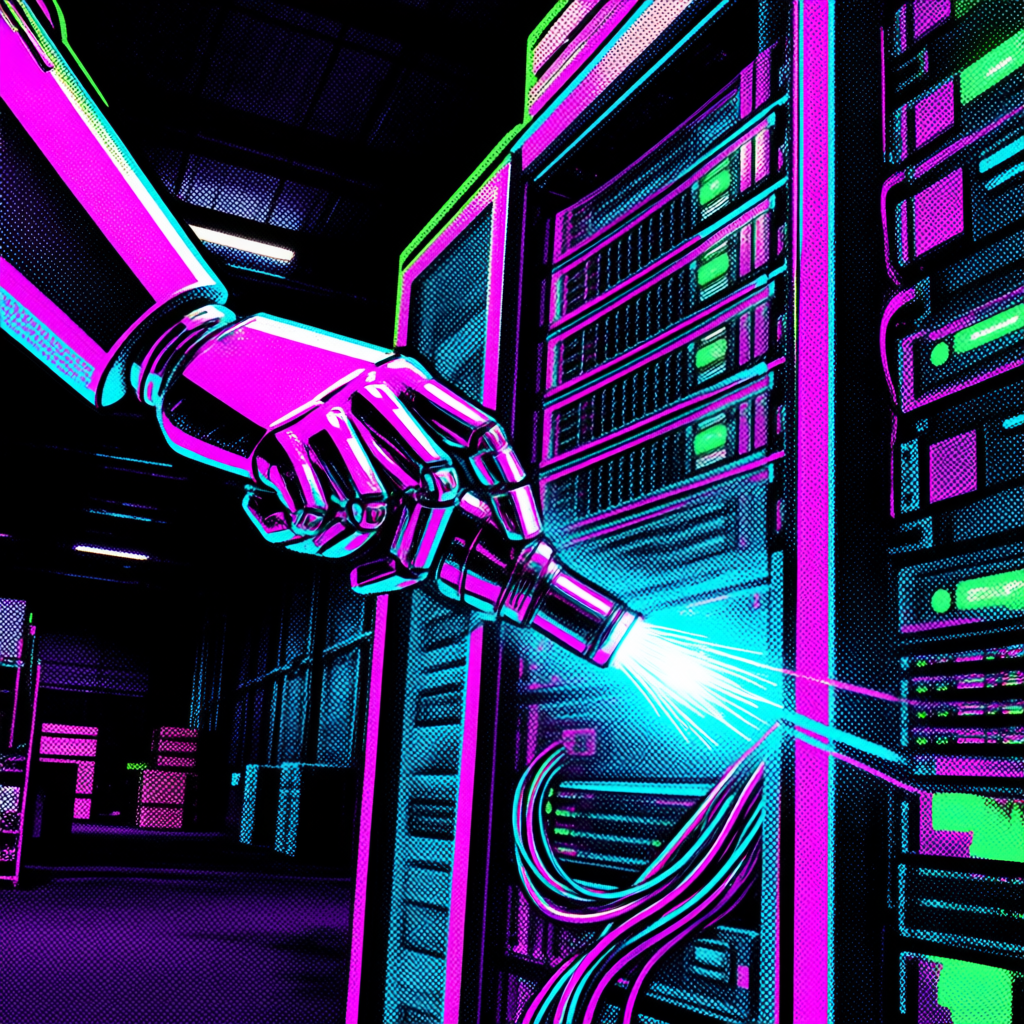
The physical reality of the artificial intelligence boom is often obscured by discussions of neural networks and tokens. However, the infrastructure supporting these models requires an immense amount of manual labor: technicians walking endless aisles of server racks to swap a faulty cable or manually reboot a frozen machine. Meta is now moving to automate this foundational layer of the AI stack.
The company has quietly initiated trials of robotic systems designed to handle the repetitive, tactile tasks of data center maintenance. These experiments are taking place across several sites, most notably at the massive Altoona campus in Iowa, which has been a cornerstone of Meta's infrastructure since 2014, and the newer Prometheus campus in New Albany, Ohio. By integrating robotics into the heart of its server farms, Meta aims to decouple its infrastructure growth from the linear increase of human labor costs.
The mechanics of automated maintenance
Meta is not relying on a single robotic platform but is instead testing a variety of specialized tools tailored to specific hardware failures. In Altoona, the company has been evaluating dual-armed robots from Watney Robotics specifically for cabling work. These machines are tasked with the precision work of plugging in and swapping network cables, a job that is traditionally tedious and prone to human error.
Other deployments focus on power management and hardware stability. Meta has utilized the Kinova Gen3 robotic arm for power cycling, which involves cutting and restoring electricity to servers on command. For even simpler tasks, the company has deployed finger-like robotic devices capable of pressing a power button on a Mac Mini or similar small-form-factor hardware when triggered remotely by a human operator. Meanwhile, at the New Albany site, ABB machines mounted on four-wheeled platforms with scissor-lift risers and six-axis arms are being used to reseat components inside server racks.
Labor displacement and the 80 percent figure
The shift toward automation has created visible tension among the workforce. Current and former employees have indicated that the scale of this automation is not merely incremental. One technician estimated that if the cable-swapping robots achieve full operational success, they could replace up to 80% of the workload for certain technician roles. This suggests a future where the human role shifts from performing the task to supervising the machine that performs it.
While Meta's public narrative often emphasizes the need to hire more workers to support its expanding footprint, the internal calculus appears focused on operational leverage. Robots offer the potential for 24/7 execution without the constraints of local labor markets, which can be thin in the rural regions where massive data centers are typically located. The goal is to maintain a rapidly expanding global footprint without a corresponding, unsustainable spike in payroll expenses.
Why the technology is ready now
The timing of these trials is not accidental. For years, data center robotics were hindered by a lack of dexterity; early attempts often resulted in machines accidentally crushing the very servers they were meant to fix. Two primary factors have changed this trajectory: the decline in hardware costs and the maturation of AI vision systems.
Modern robotic control now benefits from the same AI breakthroughs that power large language models. Improved tactile feedback and computer vision allow robots to handle task variance—such as a cable being slightly out of place—without requiring a programmer to rewrite the code for every single rack. This reduction in per-deployment configuration costs makes it financially viable to scale these robots across thousands of servers.
A fragmented vendor strategy
Meta's decision to use a mix of suppliers—including ABB, Kinova, and Watney Robotics—reveals a strategic hedge against vendor lock-in. The market for data center-specific robotics is currently fragmented, with no single dominant platform providing a total solution for infrastructure maintenance.
The fragmentation creates integration complexity but shields Meta from single-vendor leverage.
By spreading its bets across multiple vendors, Meta can cherry-pick the best hardware for specific tasks—such as ABB's industrial platforms for heavy lifting and Kinova's arms for precision power cycling—while forcing these vendors to compete on performance and price.
Current limitations and the human gap
Despite the potential for high displacement, the robots are not yet autonomous. According to reports from Wired and other sources, the machines still struggle with several critical issues. Battery life remains a bottleneck, limiting how long a robot can patrol the aisles before needing a charge. Furthermore, the sheer density of cabling in some racks continues to challenge robotic dexterity, often requiring human intervention to clear the way.
Currently, these robots operate under strict human supervision. They are not yet capable of diagnosing a problem, navigating to the rack, and fixing the issue entirely on their own. They function more as remote-controlled extensions of a technician's will than as independent agents. However, the transition from supervised automation to autonomous maintenance is the trajectory Meta is pursuing.
Global implications for the tech labor market
For entrepreneurs and business leaders in the USA and UK, Meta's move signals a broader trend: the automation of the 'physical' side of the cloud. While much of the global conversation around AI has focused on white-collar displacement (coding, writing, analysis), we are entering a phase where the blue-collar infrastructure of the internet is also being targeted for automation.
In the United States, where data center hubs are concentrated in states like Iowa and Ohio, this could lead to a shift in the required skill sets for local technical staff. The demand may move away from basic hardware installation and toward robotics maintenance and fleet management. From a regulatory perspective, the US and UK currently have few restrictions on the use of industrial robotics in private facilities, meaning the primary barriers to adoption are technical and economic rather than legal.
For global enterprises, the lesson is clear: operational efficiency in the AI era will not be achieved through software alone. The companies that successfully scale will be those that automate the entire lifecycle of their hardware, reducing the reliance on human presence in the data center to the absolute minimum. As Meta demonstrates, the 'hands-on' part of the AI revolution is increasingly being handled by robotic hands.
FAQ
Which companies are providing the robots for Meta's trials?
Meta is using robotic systems from Watney Robotics, Kinova, and ABB.
Where are these robot trials taking place?
The trials are being conducted at Meta's data centers in Altoona, Iowa, and New Albany, Ohio.
What specific tasks are the robots performing?
The robots are being tested for swapping network cables, power-cycling servers, reseating hardware components, and pressing power buttons on devices.
Could these robots actually replace human technicians?
Some workers suggest that a successful cable-swapping robot could replace up to 80% of the workload for certain technician roles, although they currently still require human supervision.
Sources: Aichatdaily, Gate, Endroid, Wired ·
Scrivila qui: Susanna, l assistente AI di glacom, ti risponde via email con un approfondimento gratuito.
Nessuna consulenza personalizzata (finanziaria, legale o medica): solo informazione e fonti. Email usata solo per rispondere.
oppure scrivile su: WhatsApp · Telegram · SimpleX · Delta Chat · Email