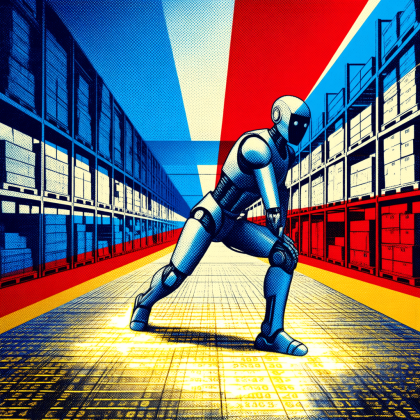




LEGO's Innovation Hub and Portugal's Shift to Industry 5.0

- LEGO Group launches the Kornmarken Campus in Denmark to accelerate concept-to-production speeds.
- Portugal implements 12 major automation projects in 2026, focusing on Industry 5.0 and cobots.
- New manufacturing trends prioritize flexible, small-batch production over traditional mass manufacturing.
- Strategic investments in robotics and sustainable facilities are redefining global supply chain resilience.
The global manufacturing landscape is undergoing a fundamental transition. The era of rigid, massive assembly lines is giving way to a more fluid model where agility, sustainability, and human-robot collaboration define competitiveness. Two distinct but parallel movements illustrate this shift: the strategic consolidation of innovation by global giants like the LEGO Group and the aggressive national reindustrialization efforts seen in Southern Europe.
The Kornmarken Campus and the speed of innovation
In Billund, Denmark, the LEGO Group has officially opened the Kornmarken Campus, a facility that represents a significant leap in how the company handles the journey from a designer's sketch to a physical product. This is not merely a factory expansion but the company's first dedicated global manufacturing innovation centre. Spanning 47,000 square metres, the campus integrates with a legacy production facility to create a total state-of-the-art complex of 100,000 square metres.
The primary objective of the LEGO Group investment is to compress the time it takes to scale new technologies across its global network. By housing 1,800 specialists from engineering, quality, and manufacturing in one location, the company aims to eliminate the silos that typically slow down industrial scaling. The campus features a Materials Lab, an Additive Manufacturing Centre, and a dedicated Test & Innovation Centre, ensuring that new production methods are vetted rigorously before being deployed worldwide.
Sustainability is woven into the physical infrastructure of the site. The facility is powered in part by a nearby solar park and is pursuing LEED Platinum certification, reflecting a broader corporate trend where the process of making the product is as scrutinized as the product itself.
Portugal's silent industrial revolution
While LEGO optimizes its global hub, Portugal is executing a wide-scale modernization of its national industry. The year 2026 marks a critical milestone for the country's Recovery and Resilience Plan (PRR), which has injected millions of euros into automation and robotics. This movement is characterized by a transition toward Industry 5.0, where the focus shifts from pure automation to a synergy between human creativity and machine precision.
A cornerstone of this effort is the PRODUTECH R3 agenda, led by Colep Packaging. This massive consortium, involving over 100 partners, seeks to develop domestic production technologies to reduce reliance on imports. The goal is the creation of flexible production lines capable of handling small, customized batches with the same efficiency previously reserved for mass production. This is made possible through the integration of collaborative robots, or cobots, and sensors that allow AI to adjust production parameters in real-time without human intervention.
Redefining craftsmanship through robotics
The application of these technologies is not limited to heavy industry; it is penetrating traditional sectors. In Northern Portugal, the footwear industry is undergoing a digital transformation via the FAIST project (Agile, Intelligent, Sustainable, and Technological Factory), led by Carité. The objective is to automate complex tasks that were historically manual, such as cutting and sewing.
Crucially, the Portuguese approach does not view the robot as a replacement for the artisan. Instead, the implementation of robotic cells is designed to provide workers with technological superpowers, reducing waste and eliminating the most repetitive, ergonomically taxing tasks. This ensures that the high quality of Portuguese craftsmanship is maintained while the throughput and sustainability of the process are drastically improved.
The transition to Industry 5.0 is not about removing the human from the loop, but about augmenting human capability with precision robotics to achieve sustainable, small-scale customization.
The shift toward flexible production models
The common thread between the LEGO innovation centre and the Portuguese robotic initiatives is the move away from the traditional economies of scale. For decades, the industrial gold standard was to produce millions of identical items to lower the unit cost. However, market demands are shifting toward personalization and rapid iteration.
The ability to produce small lots efficiently—as seen in the PRODUTECH R3 project—allows companies to respond to market trends in weeks rather than months. For a global entity like LEGO, the Kornmarken Campus provides the infrastructure to test these agile methods before rolling them out to factories across different continents. This reduces the risk of large-scale production errors and allows for a more iterative approach to manufacturing hardware.
Technological pillars of the new industrial era
Several key technologies are driving this global evolution. Additive manufacturing (3D printing) is moving from the prototyping phase into actual production, as evidenced by LEGO's dedicated centre. Meanwhile, the integration of AI and IoT (Internet of Things) is creating factories that can essentially think and adapt.
In the Portuguese context, the focus on automation and robotics is creating a domestic ecosystem of turnkey solutions. By developing these technologies locally, companies are not just buying machines; they are building the intellectual property required to maintain and evolve those machines, creating a more resilient industrial base that is less susceptible to global supply chain shocks.
Global implications for business leaders
For entrepreneurs and executives in the USA and UK, these developments signal a shift in where value is created in the supply chain. The competitive advantage is moving from those who own the largest factories to those who own the most flexible innovation loops.
In the US market, where reshoring is a major political and economic trend, the Portuguese model of Industry 5.0 provides a blueprint for integrating high-tech automation without completely eroding the skilled labor force. Similarly, UK firms looking to modernize their manufacturing base can look at the consolidation of innovation centres, like LEGO's, as a way to bridge the gap between R&D and full-scale production.
From a regulatory perspective, while the EU's AI Act will influence how AI is deployed in these automated factories, the primary driver remains economic efficiency and sustainability. Companies that invest in LEED-certified facilities and carbon-neutral energy sources, following the LEGO example, will likely find it easier to navigate the tightening environmental regulations in both the UK and the US.
FAQ
What is the main purpose of LEGO's Kornmarken Campus?
It is a dedicated global manufacturing innovation centre designed to speed up the process of moving new manufacturing technologies from the concept stage to full-scale production across LEGO's global network.
How is Portugal implementing Industry 5.0?
Portugal is using the Recovery and Resilience Plan (PRR) to fund projects like PRODUTECH R3 and FAIST, which integrate collaborative robots (cobots) and AI into sectors like packaging and footwear to enable flexible, small-batch production.
Does the increase in robotics in Portugal mean the end of manual craftsmanship?
No, the projects are designed to augment the artisan's work, using robotic cells for repetitive tasks to reduce waste and physical strain while keeping the human element central to the quality process.
What is the significance of LEED Platinum certification for the LEGO facility?
It indicates that the facility is built to the highest global standards of environmental sustainability, complemented by the use of a nearby solar park for power.
Sources: Abitotrade, Lego, Pt ·
Scrivila qui: Susanna, l assistente AI di glacom, ti risponde via email con un approfondimento gratuito.
Nessuna consulenza personalizzata (finanziaria, legale o medica): solo informazione e fonti. Email usata solo per rispondere.
oppure scrivile su: WhatsApp · Telegram · SimpleX · Delta Chat · Email