



AI Crowd Counting: The New Battleground for Political Truth
- AI was used to estimate attendance at PM Giorgia Meloni's rally in Bari, Italy.
- The AI analysis estimated 3,500 to 5,000 people, contradicting the 10,000 goal.
- The calculation relied on aerial drone footage and spatial density metrics.
- The incident highlights the growing role of AI in auditing political claims.
The age-old political dispute over crowd sizes has found a new, digital arbiter. In Bari, Italy, a recent rally featuring Prime Minister Giorgia Meloni has transformed from a standard political event into a case study on the application of artificial intelligence in auditing public claims. While organizers had publicly set a target of 10,000 attendees for the event at the cruise terminal, a different story emerged when the imagery was processed through an AI system.
The discrepancy in the numbers
Political manifestations are frequently characterized by a gap between the figures announced by organizers and the reality on the ground. In this instance, the organizers of the Fratelli d'Italia event had announced an ambition to reach 10,000 participants. However, the physical constraints of the venue suggested a different ceiling, as the chosen area had a declared capacity of approximately 3,500 people. This tension between aspiration and infrastructure created a vacuum that was eventually filled by algorithmic analysis.
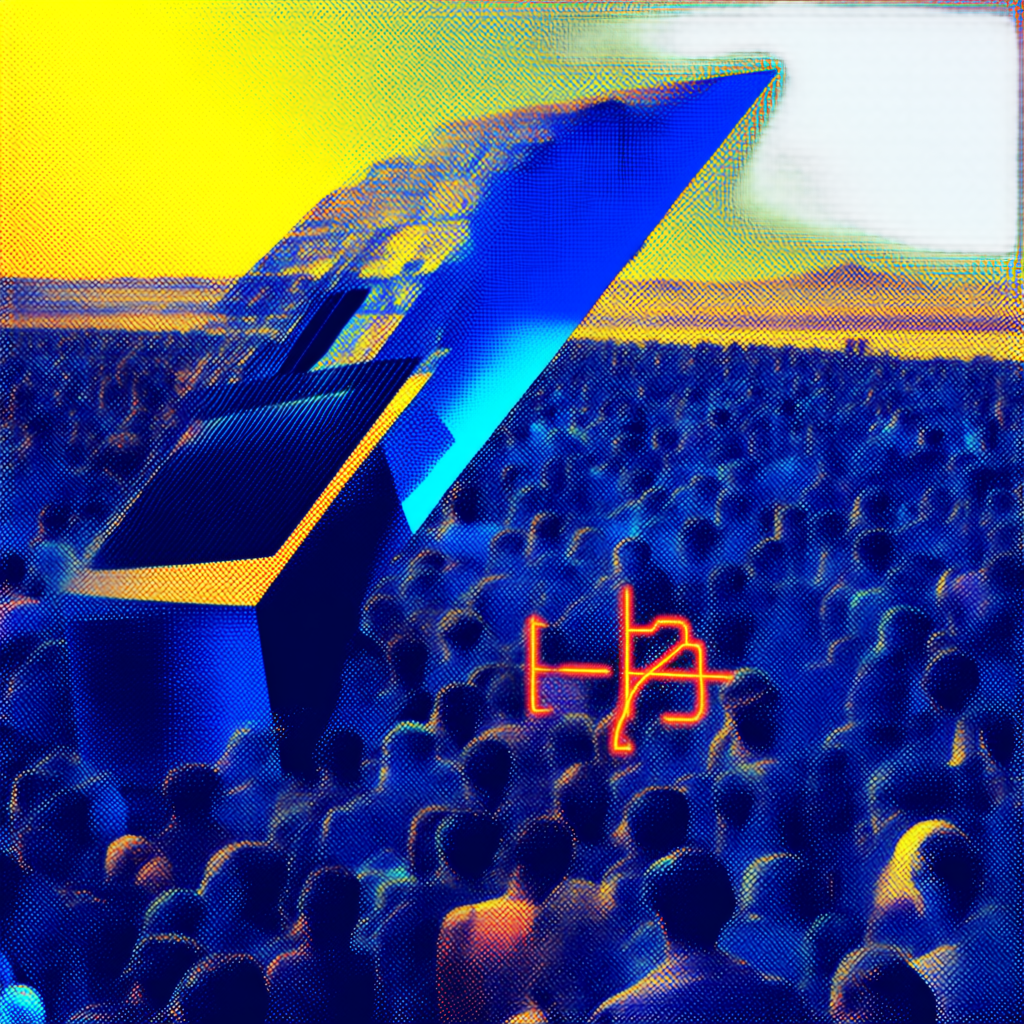
The debate intensified when Dario Ginefra, a former deputy of the Democratic Party, decided to challenge the official narrative. Rather than relying on anecdotal evidence or manual counting, Ginefra utilized an AI system to analyze an aerial photograph of the event. The image, ironically, had been distributed by Fratelli d'Italia itself, providing a high-angle drone perspective of the cruise terminal and the surrounding crowds.
How the AI calculated the crowd
The AI did not simply guess the number of people; it employed a method based on spatial geometry and known physical constants. The process began with a reference point: the width of the stage, which measured 20 meters. By using this known dimension as a scale, the AI was able to map the rest of the environment.
According to the analysis reported by La Gazzetta del Mezzogiorno, the AI determined that the crowd extended roughly 2.5 times the width of the stage at its widest point, totaling about 50 meters. In terms of depth, the assembly stretched from the front of the stage to the side corridors for approximately 3.5 to 4 times the stage width, resulting in a depth of 70 to 80 meters.
By calculating the total area occupied—estimated between 2,500 and 3,000 square meters—the AI then applied standard crowd density metrics. It accounted for higher density (2.5 to 3 people per square meter) near the stage and lower density (1 to 1.5 people per square meter) in the peripheral and transit areas. The final result was a realistic estimate of between 3,500 and 5,000 people.
A tool for political accountability
This incident marks a shift in how political opposition can challenge the narratives of governing bodies. Traditionally, disputes over attendance were settled by competing press releases or subjective visual interpretations. The introduction of AI-driven spatial analysis introduces a layer of quantitative scrutiny that is difficult to dismiss with simple rhetoric.
As noted by Immediato, the counting of presences at the Bari terminal has become a genuine terrain of political confrontation. The use of a drone photo—originally intended to showcase the success of the event—as the primary data source for a critique demonstrates a strategic pivot in digital political warfare.
The AI's estimate suggests a number that exceeds the declared capacity of the area, yet remains significantly below the 10,000 attendees hoped for by the organizers.
Limitations of algorithmic estimation
Despite the precision of the geometric calculations, the Bari case also highlights the inherent limitations of using AI for real-time event auditing. An AI analyzing a single photograph is capturing a frozen moment in time. It cannot account for the total flow of people who may have entered and exited the venue throughout the duration of the speech.
Furthermore, the accuracy of the result is entirely dependent on the quality of the input image and the correctness of the reference measurements. While the 20-meter stage provided a solid baseline, the estimation of density remains a probabilistic exercise rather than a literal head-count. Nevertheless, as reported by Quintopotere, the result provided a powerful counter-narrative to the official goals of the event.
The broader impact on public perception
When AI is used to debunk or verify political claims, it changes the relationship between the citizen and the official statement. The ability for a single individual, such as a former deputy, to run a complex spatial analysis using readily available AI tools democratizes the process of fact-checking. It moves the power of verification away from centralized agencies and into the hands of anyone with a laptop and a high-resolution image.
This trend suggests that in future elections and rallies, political organizers may need to be more cautious with their projections. The risk is no longer just a contradictory report from a rival newspaper, but a mathematically backed estimation that can be shared instantly across social media platforms, potentially damaging the perceived momentum of a political movement.
Global implications for businesses and tech
For international entrepreneurs and tech firms in the USA and UK, the Bari incident is a signal of the expanding commercial and civic utility of computer vision. The ability to transform a simple image into a data-driven report on crowd density has immediate applications beyond politics, particularly in retail analytics, urban planning, and event management.
From a regulatory perspective, this use of AI falls into a grey area. In the US, where the approach to AI is largely sectoral and driven by market innovation, such tools are seen as efficiency boosters. In the UK, the focus remains on safety and reliability. However, for companies operating within the EU, the AI Act provides a framework for high-risk AI systems. While crowd estimation for a political rally is not necessarily a high-risk biometric identification process, the use of AI to influence public perception or monitor gatherings could eventually attract regulatory scrutiny regarding transparency and data privacy.
Businesses specializing in AI-driven analytics should note that the demand for transparency is growing. The market is moving toward a need for verifiable, auditable AI outputs. As seen in Italy, the value is not just in the number produced, but in the methodology—the reference points, the density variables, and the geometric logic—that allows the result to stand up to public scrutiny.
FAQ
How did the AI determine the number of people at the rally?
The AI used a 20-meter stage as a scale to calculate the total area occupied by the crowd (roughly 2,500-3,000 square meters) and then applied average density metrics for outdoor events.
What was the difference between the AI estimate and the official goal?
The organizers aimed for 10,000 attendees, while the AI estimated the actual presence to be between 3,500 and 5,000 people.
Was the AI analysis based on a live feed?
No, the analysis was performed on a single aerial drone photograph that had been released by the Fratelli d'Italia party.
Why is this event significant for the tech industry?
It demonstrates how computer vision and spatial analysis can be used as tools for political accountability and fact-checking in real-time.
Sources: Lagazzettadelmezzogiorno, Immediato, Quintopotere ·
Scrivila qui: Susanna, l assistente AI di glacom, ti risponde via email con un approfondimento gratuito.
Nessuna consulenza personalizzata (finanziaria, legale o medica): solo informazione e fonti. Email usata solo per rispondere.
oppure scrivile su: WhatsApp · Telegram · SimpleX · Delta Chat · Email